Showing posts with label plants. Show all posts

Friday, September 14, 2012

ENVIRONMENT / GREEN II - Big interest in medical plants on open day - SEYCHELLES


A large crowd attended an open day on traditional medicine organised by the national heritage and research section of the Ministry of Education at La Bastille on Friday.
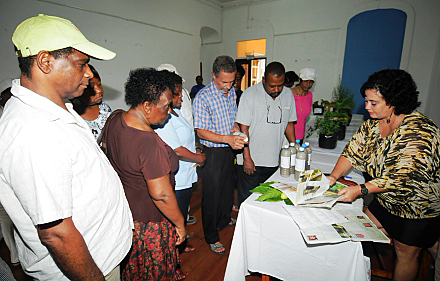
Description: The open day on traditional medicine attracted a large crowd who was particularly interested in the Bwa torti
On exhibition were many plants found in Seychelles which are reputed to have medicinal virtues.
Also on display were several books on the best ways to lead healthy lives.
But, it was the Bwa torti or Noni which attracted the most attention.
The juice is derived from the tree of the Morinda citrofolia, a beautiful tree growing in Seychelles and in other tropical areas, such as Tahiti, Samoa, Tonga, Malaysia and Northern Australia.
A presentation by Marie-Andree Contoret aroused a lot of interest. She noted that the juice is a cure for a wide range of illnesses, in addition to boosting the immune system.
She said Bwa torti is a cure notably for inflammations, such as arthritis, skin rashes and even chronic conditions, such as diabetes, cancer and cardiac diseases.
The juice is extracted from the fruit when ripe, using a blender. It is then allowed to ferment in air-tight containers – to avoid contamination – in the sunlight for up to seven days.

There is usually a pungent smell, but this Ms Contoret said should be disregarded “as we should be focussing on its medical and curative virtues”.
She said she has also turned the fruit into jam, but would not advise persons with diabetic conditions to do that or add any sweeteners to the Bwa torti juice, which is normally taken in doses of two tablespoonfuls or four ounces daily.
Depending on the person, it can be taken in two dosages, morning and evening. For acute cancer, up to 30 ounces can be taken daily, but this depends on the individuals.
A reference book following research on the Morinda citrifolia by Melanie Alfred, of Brisbane Australia which Ms Contoret exhibited at the open day, states that some constituents include different amino acids, glycosides, vitamins and minerals as well as sugars, including fructose and glucose.
A few of the medicinal uses of Bwa torti are for digestive problems, such as diarrhoea, intestinal worms, nausea and food poisoning. It is also good for respiratory problems, such as congestive cough, tuberculosis, infant chest colds and sore throat.

The syrup of the fruit has also helped treat asthma, dysentery, gastric ulcers and diabetes.
Research at the French University of Metz claims that the analgesic activity of Bwa torti eases many types of pain. It was found to be 75% as effective as ordinary doses of morphine.
Another well-known local herbalist, Jean-Joseph Madeleine, advised against abuse of Bwa torti or any other medicinal plant. Responding to questions, Mr Madeleine said most medication prescribed by doctors can be taken along with traditional herbal medicine.
Those present agreed when a patient is taking one kind, he or she should refrain from taking a different kind of medicine as a precautionary measure as some substances can be reactive against another, leading to undesired effects.

For instance, it is a long held belief that Aspro, a mild pain-killer, should not be taken along with Yapana, an herb used to ease stomach pains.
Various health publications, such as Healthy Body, Understanding Nutrition, Medicinal Plants of Seychelles and How to reduce and survive cancer were also on sale during the open day
There was also a special issue of the plant conservation group newsletter Kapisen, which focuses on the Seychelles National Herbarium, located in the Natural History Museum in Victoria.
Source: NATION 9-3-12


Thursday, July 12, 2012

ENVIRONMENT - SEYCHELLES


Seychelles plant gallery -- a project for everyone


Did you watch the film about Seychelles plants on Wednesday evening May 16? - “Antigonn – Zakobe: Eski ou konn bann plant Sesel?” If you did, we hope that you came away knowing more about the many species and varieties of plants growing on our islands, and also why they are important in our lives.


But, if you see a plant in a garden or in the forest and you do not know what it is – can you identify it?

There are several books on sale about plants of Seychelles, but much of the current information about local plants is in scientific books and papers. Many of these are difficult to access and tricky for the non-specialist to read.

Another source of information is the National Herbarium, but the pressed plants which form this collection are stored in a small room inside the Natural History Museum, and you need help with using them for identification purposes.

The internet may be of help but usually you need to know something about the plant before being able to look it up! So is there another way?

In the film you could also learn about the Herbarium Project being carried out by the local NGO, Plant Conservation Action group (PCA) in collaboration with the Natural History Museum in Victoria. This project is being funded mainly by a grant from the GEF Small Grants Programme and the Environment Trust Fund. One of the aims of the herbarium project is to provide you with an easier way to identify and learn more about the plants of Seychelles, both native and introduced. And the herbarium will soon become much more than just a collection of dried pressed plant specimens!

We are creating a “Seychelles Plant Gallery” – photographs and information about all the plants in the country, which you will be able to access through the internet or in the Natural History Museum. But at the moment there are still many gaps! We know little about new ornamental species which have been brought into the country in the past 30 years; we do not have records for many of the agricultural species, particularly the older varieties; some invasive species are spreading fast and some useful plant species are becoming rare - we need to know where these plants are located now as this will be valuable information for the future.

If we tried to fill all these gaps on our own it would take us several years and the money would not be enough, so this is where we need your help. Many of you are very knowledgeable about the plants growing in your gardens and in your surroundings. So, if you help us, we can build up this information and a collection of photos together. Your contributions will be added to the Seychelles Plant Gallery, and we hope that it will become a useful tool for you also, a resource which you can use whenever you want. This project then becomes something special – it will be created by the people for the people.

Over the coming weeks we will provide more information about how you can contribute and which group of plants (or themes) to focus on each month. Also, watch out for the herbarium leaflet, a special printed edition of our newsletter “Kapisen” about the project, a plant photo competition and an exhibition about plants of Seychelles.

In the film, the Wildlife Club children shout “Yes Miss” when asked to take part. We hope that you will join us too. Even if you think that you don’t know very much, perhaps you have been curious about the strange plant on someone’s property or a new plant you hadn’t seen before. We want to know about that plant too – it might be something really interesting that we haven’t seen before either!

Contributed by the Plant Conservation Action group (PCA) and the Natural History Museum

Thursday, June 7, 2012

LIFESTYLE - USA

The future of ‘famine foods,’ unconventional edibles in the garden

They’re called poor people’s foods. Plants foraged by starving folk and scavenged when crops succumb to drought: They’re what you eat just to get by. Many are unusually rich in nutrients, have medicinal value and may even taste good. But because they’re free for the taking they get little respect.
Scientists in fields such as ethnobotany study them and the ways they are eaten. But the true experts are indigenous people all over the world who’ve inherited them as part of their culture.

 
To the rest of us, who rely for our food on an alarmingly few species of plants grown on an industrial scale, these wild edibles are a gardener’s curiosity that may hold the key to a more sustainable way of feeding the world in the years to come.
A treasure house of knowledge about survival plants can be found on the Famine Foods Web site, sponsored by the horticulture department of Purdue University. Browsing through its database, you might be surprised to see a number of foods that are in your yard, such as the leaves of forsythia — eaten in China with oil and salt — or a garden narcissus that the French turn into flour. Will times ever be so bad that you’ll need to nibble the edible leaves of your expensive Japanese maple? Unlikely. But it’s useful to know that a pesky species like shepherd’s purse, a common weed, is a nutritional powerhouse, and that roots from the evil, tree-smothering kudzu vine, steamed and eaten, could someday save your life.
For the most part, though, these names are mysterious and surprising in their numbers. There are well over 1,000 listed, and many more could be discovered by searching beyond the world’s standard fare. It seems that all parts of a plant are tried — leaves, stems, root, seeds, bark — until someone who is as indomitable as the plant itself finds a way to consume it.
In one entry after another, these foods are made tastier by the addition of salt, oils, chile peppers and other condiments. At times they’re blended with staples such as common flours to stretch the supply. Some must be repeatedly soaked and drained, or boiled, to reduce bitterness.
Even more important are the tricks to reduce the toxicity that some foods possess, knowledge that’s in danger of being lost as these plants lose their habitats or fall further into obscurity. As the world’s population expands, we’ll need crops that grow when nothing else will.
Robert L. Freedman, who created and compiled the database and whose “Notes on the Famine Foods Website” gives a fine account of the subject, writes that there is no time to be lost in studying and rescuing both the plants and their lore. “Among these, known famine plant species may provide alternatives to costly Green Revolution approaches to providing staple crops for areas of the world in greatest need of food production self-sufficiency.”
And who knows which among them might someday be culinary darlings? I recall a native poverty food of ours, the eating of which was once so shameful that its remains were quickly buried. It was called the lobster.

Damrosch is a freelance writer and the author of “The Garden Primer.”
Tip of the week
Provide a decorative and useful edge to the vegetable garden with a row of okra plants. Sow seeds now and thin after germination so plants are spaced 18 inches apart. Plants can grow as high as seven feet, depending on variety. Soak seeds overnight before planting to speed germination. Apart from local garden centers, a good source of okra seeds is Southern Exposure Seed Exchange (540-894-9480, www.southernexposure.com).