Showing posts with label hope. Show all posts

Thursday, December 20, 2012

FRIDAY DECEMBER 21ST - GOOD THINKING - GOOD WISH - GOOD WILL DAY!! SHARE!!


FRIDAY DECEMBER 21ST – WORLD MEDITATION DAY! GOOD THINKING - RECCOMENDED!! / INVITE YOUR FRIENDS AND EVERYBODY!

This FRIDAY, DECEMBER 21, I Invite you to spend from one to five minutes meditating or just thinking about something in this world you want, can and would like to be improved......


It can be to stop the war , stop the poorness in the least developed countries, stop cntamination and global heating, or even something more personal, like get closer to people you would like to, say i love you to somebody you feel like, or just wish the best and happiness to whoever you want even yourself.


But it would be great to have everybody involved in this, for which tell your friends, family co-workers, known people, even your enemies if you have, your ex friends, your ex boyfriend of girlfriedn, everybody is invitred to share something that just need to have one thing: A GOOD THINKING OR A GOOD WISH

 
Because the place where we go is the same and the world that we live belongs to all of us, lets give him an opportunity and hope to be with us and we be in it for the rest of our live and let all the future generations enjoy a good, perfect and wonderfull world as it is today

 
And whatever you do or think, and whoever want to participate on this is invited, because there will be always an open door, no matter sex, race, religion, thiking or whatever distinction that the society may do or have, but most important than anything, we are all just one and perfect HUMANITY


Friday, July 13, 2012

SATURDAY JULY 21ST – WORLD MEDITATION DAY! GOOD THINKING - RECCOMENDED!! / INVITE YOUR FRIENDS AND EVERYBODY!


This SATURDAY, JULY 21ST WE Invite you to spend from one to five minutes meditating or just thinking about something in this world you want, can and would like to be improved......


It can be to stop the war in Syria, stop the poorness in the least developed countries, stop cntamination and global heating, or even something more personal, like get closer to people you would like to, say i love you to somebody you feel like, or just wish the best and happiness to whoever you want even yourself.


But it would be great to have everybody involved in this, for which tell your friends, family co-workers, known people, even your enemies if you have, your ex friends, your ex boyfriend of girlfriedn, everybody is invitred to share something that just need to have one thing: A GOOD THINKING OR A GOOD WISH


Because the place that we go is the same and the world that we live belongs to all of us, lets give him an opportunity and hope to be with us and we be in it for the rest of our live and let all the future generations enjoy a
good, perfect and wonderfull world as it is today


And whatever you do or think, and whoever want to participate on this is invited, because
there will be always an open door, no matter sex, race, religion, thiking or whatever distinction that the society may do or have, but most important than anything, we are all just one and perfect HUMANITY


Wednesday, July 4, 2012

HEALTH + HOPE - IRELAND


Even when you're sick you can have fun

ELYSHA FOLEY

MY HEALTH EXPERIENCE: ELYSHA FOLEY is 14 years old. And although she looks and sounds like most other girls of her age, she has led a completely different life to date.

When she was just four years old, the Clare girl had problems with her eyesight and a strange compulsion to sink her teeth into things. For over a year she underwent a battery of tests to try to find out what was wrong with her and, at the tender age of five, was diagnosed with a brain tumour.

She has spent the past decade fighting this crippling disease, putting up with endless tests and lengthy hospital admissions, enduring gruelling bouts of chemotherapy and several operations but has finally come out the other side as a happy, healthy teenager.


WHEN I was four, I had a problem with my vision. My left eye was getting weaker and weaker and I had to wear an eye patch and glasses. Every morning I would pick out a cartoon figure sticker, usually a Disney princess one, and Mum would put it on my patch. I hated wearing that patch as it was very uncomfortable.


I would also leave teeth marks on everything and got into trouble at school because I used to eat all the pencils and crayons and bite the corners off the desks. I even bit a girl’s arm once. The doctors later said I might have done this because of pressure in my brain but I never felt any pressure there. I felt normal.

I had a lot of tests done including Cat scans, MRIs, ECGs, kidney tests, hearing tests and lumbar punctures.


When I was five, I was diagnosed with a brain tumour on my optic nerve, at the point where the nerves cross each other, right in the middle of my brain. It was inoperable. That means you can’t have an operation to take it away. So I had to start chemotherapy.


On my first day in St John’s ward in Crumlin I met my oncologist and my neurosurgeon. They were very nice, they explained about my tumour and showed me a picture of it from my MRI. It was a shiny circle in the middle of my brain. It actually looked very pretty, like a bright star in the middle of my brain.


I remember thinking that everybody was lovely – the nurses were so nice. All the kids had no hair and were very white. I had surgery the next day to have my broviac line put in. This is a white tube that goes in to my main vein just above where my heart is. All my meds, chemo, infusions and transfusions went through this.


The minute the chemo goes into the line you can feel it burn up through your body. It stings for a while but it’s okay, as Mum says it’s good/bad medicine and you have to get sicker to get better.


I had fun when I was in hospital. We were all in the same boat. In the outside world people would stare at me. But in Crumlin we were all the same, we had no hair and we all had wonky blood counts. We would play lots of games. When we were on our chemo, which takes hours, my friends and I would run and then jump on the wheelie thingy that the chemo bag [was hanging] from and have races down the corridor. The doctors and nurses would have to jump out of our way.

There is lots of goofing around in Crumlin. It’s important to know that even when you are sick you can also have great fun.


Throughout my sickness, Mum was always with me, she never left my side. She slept in a fold-away bed beside me. At times when I was very sick she would sleep with me in the bed and hold me so tight. I liked that. It was very hard on my family when I was sick. Mum had to give up her job. Dad had to mind my brother at home and this was hard on them. I missed my brother (Gearóid) and Dad so much.


Dad is a big softie and although Mum can be a softie too, she is very calm when things go wrong. She minded me all the time; she would clean my wounds, change my dressings and make me my favourite food in the kitchen on John’s ward so I would feel like I was at home.

I would like to say I was always brave and most of the time I was but there were times when I was so ill I wanted to give up. I was just so tired but Mum would always say, “You have the best doctors, the best medicine, but you have to do your

 part too, you have to fight it.” She always pushed me on.

Last summer I went to Barretstown and it was brilliant. We didn’t just sit around being sick, we just had non-stop fun. We got to ride in rally cars through country roads which was terrifying but great craic. Then when we arrived back at the castle, there was a red carpet waiting for us and people asking for autographs – we were like film stars.


I made loads of friends from different countries and even though we didn’t speak the same language, we understood each other because we have all gone through the same thing.


When I was sick I lost my confidence because I missed out on doing normal things. My time in Barretstown gave that back to me. I got to do things I never thought I would be able to do. I felt more at ease, I was able to open up, to let go and just have fun.


Every night I went to bed with a smile on my face, exhausted from doing lots of crazy, fun things during the day. Having cancer turned out to be a really good thing as I got to go to Barretstown and will return there when I’m older to work as a Cara and give back what it gave me – smiles.


As my mum said, the chemo may deal with the physicality of cancer, but cancer leaves very deep hidden scares and that’s where Barretstown comes into its full power.

Monday, July 2, 2012

CHILD / HOPE - CHINA

'Lost' generation given hope

Updated: 2012-06-28 07:58

By Yang Wanli (China Daily)

Shelters offer care to those living rough on the streets, Yang Wanli reports in Beijing.

'Lost' generation given hope
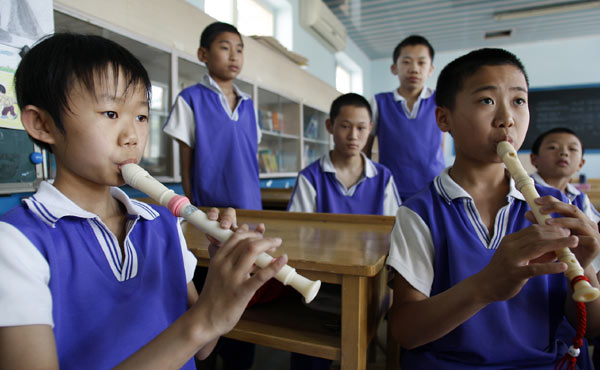
Xiaoya (left) plays the recorder along with fellow students at the Beijing Juvenile Rescue and Protection Center. The 12-year-old, who has malformed legs, was abandoned by her grandmother at an early age. Photos by Zhang Wei / China Daily

Wang Ming has visited three provinces in China since the beginning of 2011. That's not bad going for a 12-year-old. Without a guidebook or a change of clothes, the boy took nothing but 200 to 300 yuan ($31 to $47) for each trip. Sharing a passion for globetrotting with his hero Bear Grylls in the TV program Man vs Wild, he has attempted to realize his dreams by becoming a runaway.
At a juvenile center in Beijing, Wang is among 40 children brought in off the streets. Some ran away from home, others were abandoned. Since it opened in 2003, the center has helped more than 5,000 "lost" children.
It's difficult to gauge how many children are living rough on China's streets, but on June 1 the Ministry of Civil Affairs revealed that more than 10,000 juveniles nationwide had been rescued or were being given shelter and protection in government-run centers from January to April this year.
A 2007 survey conducted in nine cities, including Beijing, Hangzhou and Shanghai, by the National Working Committee on Children and Women under the State Council, estimated the number to be between 1 million and 1.5 million.
Situated close to Beijing's East 5th Ring Road, the pink roofs of the center's six bungalows are bright and vivid in a sea of gray or white buildings. Youngsters aged 3 to 18 - mostly from rural areas in provinces such as Hebei, Henan, and Sichuan and the Ningxia Hui autonomous region - make up the bulk of the inhabitants.
"The children sent here are those who can't remember where they're from or who haven't contacted their relatives for many years," said Xu Dong, director of the center, who explained that domestic abuse, difficult relations with parents or a cripplingly low standard of living are the reasons usually cited when the children are asked why they ran away.
Wang's story is slightly different. His parents are divorced and Wang and his older sister have been living with their father in a village in Jiangsu province in East China. Wang's father works in construction and rarely has time to devote to his children or their education. Wang found himself at a loose end. "I don't like school or the village. They're so boring," he said, his dark eyes twinkling mischievously.
Xu said that many of the children give false names and lie about their backgrounds when they are first admitted to the center to avoid being sent home, but they usually end up admitting the truth once they learn to trust the staff. That was the case with Wang, who was persuaded to reveal his real address and contact details for his father. "I don't want to stay here, even though it's nice to have clean clothes and sleep in a comfortable bed," he said.
He ran away from home earlier this month and sneaked onto a Beijing-bound train. This latest escapade followed two previous attempts to break free when he traveled to the provinces of Guangdong and Yunnan "to see those beautiful sites", he admitted, as he described the bridges and mountains he'd seen. With little money in his pocket, he ate food provided by locals until the police sent him to the juvenile center.
According to Xu, this type of "free traveling" is quite normal for runaway kids. They can easily avoid detection and the ticket checks on trains, although Wang occasionally bought a ticket using an ID card he found in the street and the money he had "borrowed" from home.

'Lost' generation given hope
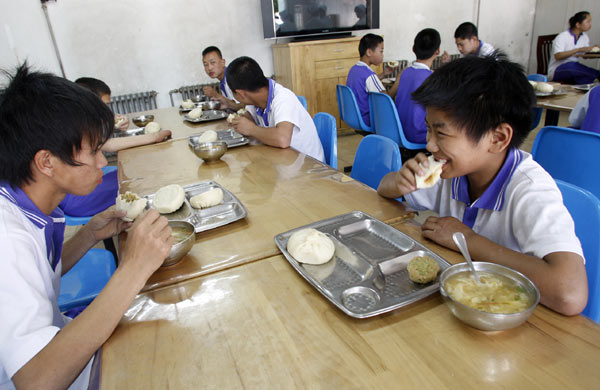
Street child Wang Ming (right) has dinner at a juvenile center in Beijing. Zhang Wei / China Daily

Wanderlust
The mini-adventurer is driven by wanderlust. "I saw people traveling to famous places on TV, and I wanted to be just like them," he said. In the early days of his trip to Beijing, his love of TV prompted him to visit the Military Museum of the Chinese People's Revolution. "I knew the museum from a TV program. It's a place I dreamed about," he said.
Like Wang, who is moving from childhood to a sense of self engendered by adolescence and beginning to pursue his own choices, most of the children at the center are 11 to 16 years old but few have close connections with their immediate family.
However, their lifestyles have provided them with strong survival skills. Roaming the bar areas of the North 2nd Ring Road, Wang spent most of his days in electronic games arcades, picking up dropped coins to feed the machines, and slept on park benches at night. A number of residents provided food, including an African man who piqued the boy's curiosity. "I took a bus to the international airport and asked the service people how I could get to Africa. I even showed them the ID card," he said. "But, they refused to let me travel, saying that I could only go there with my parents."
After a few days on the streets of the capital, the police sent Wang to the rescue center. Once the boy revealed his real address, Xu contacted Wang's father, who refused to take his son back, reasoning that he will almost definitely run away again. "If the local government in his hometown can't send someone to collect him, we will have to send him back alone," said Xu.
Basic education is provided for long-term residents and the center is supplied with books covering the entire nine-year school curriculum. Although there are only about 40 students in the class, far fewer than in ordinary primary schools, teaching is not an easy task. Every 60-minute lesson is split into three, 20 minutes allocated for each group, with students taught according to their ability and previous educational background.
"Teaching those students really takes a great deal of patience and advanced skills," said Feng Guixia, a 59-year-old who teaches Chinese and mathematics. She has been working at the center, earning 1,500 yuan ($236) a month, since retiring from her job as a teacher at a nearby school five years ago.

'Lost' generation given hope
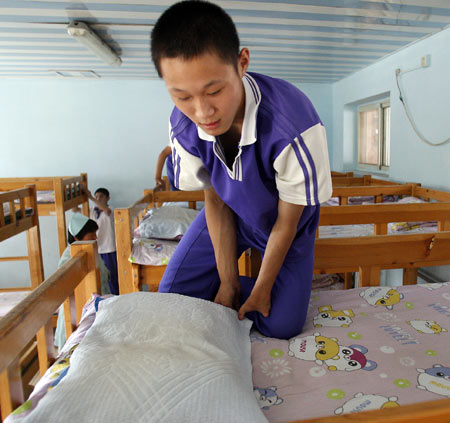
Li Shengli, who arrived at the center in 2005, makes his bed. Born with just vestigial digits and not fully formed fingers, the 15-year-old was abandoned on a train by his parents.

Just like a family
"The bonds that connect the kids are very touching," she said. "Unlike a lot of children nowadays, the kids here always share what they have, whether it's delicious food, new toys or other things. The youngest child is always treated well, just like in a family," she said.
Roughly 90 percent of the children sent to the center are eventually reunited with their families, but the others, those that have been abandoned, are destined to live there until they are 18. Li Shengli, 15, who arrived at the center in 2005, was abandoned on a train. "I was traveling with my parents and fell asleep. When I woke up, they had gone," he said, avoiding eye contact and rubbing his left hand on his clothes. His hand looks unusual because he was born with just vestigial digits and not fully formed fingers. He doesn't know if that is the reason he was abandoned.
Li said he can't remember anything about his birthplace and little about his family, but he knows that he has an older sister and a brother. When asked if he wanted to find his family, he looked down at the floor and shook his head.
He perked up momentarily only when he spoke of the things he's seen and done. "I love the Great Wall. It's so long and so beautiful. We climbed for hours until our legs were tired and we could hardly take another step. We went to the highest part and saw the lovely scenery, colorful trees, blue sky and birds," Li smiled. "I know where Beijing is. It's on the neck of the cockerel (to many people, the depiction of China on the map makes the country look like a crowing cockerel)."
But his interest evaporated when he spoke of life outside the center, a life with which he's unfamiliar and a frightening prospect: "I dare not explore the outside world. If I leave here, I will just be homeless again," he said.
Contact the reporter at yangwanli@chinadaily.com.cn
Tang Yue and Wu Wencong contributed to this story.

Friday, June 22, 2012

HEALTH / LIVING - UNITED KINGDOM

'You can't win them all': Schoolboy with terminal brain tumour amazes friends and family with his brave attitude to death


  • 16-year-old has elected to stop having chemotherapy and hopes to make it to his school prom

  • David's mother says she has learnt how to cope thanks to her son's strength

  • Children have the same risk of getting a brain tumour as getting meningitis


A schoolboy dying from a brain tumour has stunned his family with his bravery after responding to his terminal condition by saying: 'You can’t win them all.'

David Langton-Gilks, who is just 16, said he has accepted he is 'stuffed' following a five year battle against the disease.

Up until five weeks ago David thought he had beaten the Medulloblastoma tumour but relapsed an hour after posting a video on YouTube telling the world he was recovering.


David Langton-Gilks has decided he wants no more treatment after being told his brain tumour is terminal


Scroll down for video

His parents, Sacha and Toby, took him to hospital where scans showed the cancer had returned and spread from his brain down his spine.

Doctors told the family the condition was now terminal and David and his parents decided not to prolong David’s pain and suffering by giving him more chemotherapy or radiation.

The teenager may have just weeks left to live and is focusing on making it to his school leavers prom on June 28.


David said: 'I’ve relapsed several times - but now I’m kind of stuffed. But hey, you can’t win them all.'

David, from Fontmell Magna, in Dorset, hasn’t been able to go to school for the past month because his short-term memory is so badly affected by the tumour. He also relies on 15 tablets a day to help with the pain.

His mother has launched an awareness campaign to highlight the importance of detecting brain tumours in children at an early stage.


David, pictured surfing in Cornwall, had been an active teenager who had loved playing the guitar. He now enjoys cooking

Although David displayed the symptoms of the disease when he was 11, they were not simultaneous and it took five-and-half weeks to get a diagnosis.

Had it been detected sooner, the tumour would have been around half the size it was and David would have stood a much better chance of survival.

The symptoms of the Medulloblastoma brain tumour include vomiting, headaches, and unusual eye movements.

David has undergone several operations since the age of 11 to remove the golf-ball sized tumour but has since suffered two relapses.


David's mother, Sacha Langton-Gilks. She said David has shown her how to cope by being so strong

He said: 'Before I was diagnosed I was feeling really weird, sicky and getting really bad headaches. I thought I was coming down with something.

'It came on so slow that it became like a normal thing.'

Mrs Langton-Gilks, a 44-year-old singing teacher, said: 'If I had realised before he still would have had the cancer but the tumour would have been half the size if I had got there first.

'His tumour was the size of a golf ball. He had two operations on it and then radiotherapy for six weeks alongside chemotherapy, followed by 48 weeks of combined chemotherapy.

'He has been so strong but we are in our fifth week now since we were told the cancer had come back in May.

'It means that next week is the sixth week which is usually the maximum time, so it will be a miracle if he can make it to his prom.

'Just last month we thought everything was alright, we had put the video on Youtube just an hour before he had a Taekwondo lesson.

'He came home saying he couldn’t see properly and couldn’t remember anything.

'When he had scans a few days later it showed the cancer had come back, in his brain and down his spine.

'We sat there and David said ‘no more treatment’, then he was very quiet, children accept it much better than grown ups.


'Instead, I felt like the child, it was horrible and very hard because what adults can’t deal with is them being so honest and accepting.

'He’s taken the bad news extremely well and has all the way through, which is typical David, when he has a terrible day he just says ‘that’s what it’s like’.

'He’s shown me how to cope, you think it would be the other way round but not at all, he is so strong.

'Day-to-day things are hard, he is deteriorating and is very upset that he can’t remember how to play his guitar, so he is spending time cooking and playing games with family.'


Read more: http://www.dailymail.co.uk/health/article-2162578/You-win-Schoolboy-terminal-brain-tumour-amazes-friends-family-brave-attitude-illness.html#ixzz1yVpeMcxz

Wednesday, June 20, 2012

SUNDAY JUNE 24TH - WORLDWIDE MOVEMENT OF GOOD THINKING - RECCOMENDED!! / INVITE YOUR FRIENDS AND EVERYBODY!

This Sunday, June 24 I Invite you to spend from one to five minutes meditating or just thinking about something in this world you want, can and would like to be improved......


It can be to stop the war in Syria, stop the poorness in the least developed countries, stop cntamination and global heating, or even something more personal, like get closer to people you would like to, say i love you to somebody you feel like, or just wish the best and happiness to whoever you want even yourself.

 But it would be great to have everybody involved in this, for which tell your friends, family co-workers, known people, even your enemies if you have, your ex friends, your ex boyfriend of girlfriedn, everybody is invitred to share something that just need to have one thing:                                    A GOOD THINKING OR A GOOD WISH


Because the place that we go is the same and the world that we live belongs to all of us, lets give him an opportunity and hope to be with us and we be in it for the rest of our live and let all the future generations enjoy a good, perfect and wonderfull world as it is today


And whatever you do or think, and whoever want to participate on this is invited, because there will be always an open door, no matter sex, race, religion, thiking or whatever distinction that the society may do or have, but most important than anything, we are all just one and perfect HUMANITY


PEACE

Monday, June 11, 2012

HEALTH - KOREA

Sick girl gets new lease on life after 7-organ transplant


FEBRUARY 17, 2012 08:03

“I’d like to eat hamburgers to the fullest as my friends.”
This is the wish of Cho Eun-seo, a 7-year-old girl who could not digest food well until a few weeks ago. She used to vomit most of the food she ate. As she absorbed just 30 percent of the food that she did not vomit, she needed injections to get supplemental nutrients.

She also suffered from chronic intestinal pseudo-obstruction syndrome, a rare disease that afflicts just 10 people in Korea. Just 87 percent of patients survive for a year and 70 percent for four years.

The only cure is an organ transplant. Cho, however, had to get transplants for seven organs: liver, pancreas, small intestine, stomach, duodenum, large intestine and spleen. Astonishingly, the young girl has received all of the organs she needs.

A team of doctors led by Kim Dae-yeon at Asan Medical Center in Seoul said Thursday that they transplanted seven organs of a brain-dead donor to Cho on Oct. 12 last year. The donor is known to have been a six-year-old brain cancer patient who was pronounced brain dead due to increased cerebral pressure.

Kim registered Cho with the Korean Network for Organ Sharing two years ago and prepared for the multiple organ transplant surgery that requires removing almost all of the organs from Cho’s abdominal cavity.

The operation took nine hours because it required the removal of nearly all abdominal organs and their replacement with new ones simultaneously. As no hospital in Korea had transplanted more than three organs at the same time, so the prospects of the operation were murky.

Cho began eating food through her mouth two weeks after the transplant. One month later, she weaned from nutrient injections and began getting nutrients from meals. She was transferred to a general ward in December last year, and will leave the hospital around Feb. 20.

“Due to problems related to blood type and organ size, organ transplants for children is much more difficult than that for adults and the success rate is very low,” Kim said, adding, “Fortunately, the donor’s organs were similar to those of Cho. So the transplant was successful.”

Cho’s mother said, “She recovered her laughter while practicing eating food. This is like a dream,” adding, “I thank the medical team for going to great lengths to perform this difficult surgery.”

Kim said, “The surgery has given hope to those suffering from rare diseases with low survival rates that they can make a complete recovery,” adding, “It is most glad to me that Cho can return to kindergarten and school.”

Monday, May 28, 2012

SOCIEDAD / TIEMPO LIBRE - URUGUAY

Compañeros de ruta que se eligen


La amistad es considerada como la más libre de las relaciones humanas.


Lolola nimina". De esta manera, cuya traducción del lenguaje infantil al castellano sería "Señora divina", la niña Rosario Ambrosini, hoy una actriz de 58 años, se refería a Cristina Morán cuando la veía en televisión. Varias décadas y trabajos conjuntos después, se han transformado en amigas inseparables. María Filippi (53), también actriz, también forma parte de ese grupo íntimo que se reúne siempre que sus obligaciones lo permiten; Carmen Morán, hija de Cristina, suele unírseles. Las carcajadas resuenan en el céntrico bar San Rafael. Rosario cuenta de la inminente llegada de un sobrino-nieto, para alegría de todas. Más allá de "la química" o las "posturas similares ante la vida", ninguna puede dar una explicación racional a ese sentimiento. Desde hace unas dos décadas son amigas y punto; y eso no se discute más.
La diferencia de edad no se nota. "Yo entré a trabajar a la radio a los 17 años y cambié todo mi ritmo de vida, por eso no tengo amistades de décadas atrás", dice Cristina sin sombra de tristeza. "Yo no acepto la separación por generaciones. Cuando nos juntamos… ¡somos tan bobas que lo que hacemos es pasarlo bien, reírnos! A mí me gusta mirar para adelante. Tengo 81 años, ¡qué voy a andar mirando para atrás!", larga la carcajada "Lolola", como aún la llama Rosario, amparada por la intimidad de ese micromundo que les pertenece a ellas.
A diferencia de lo que ha pasado con el amor, la psicología ha indagado poco el tema de la amistad, admite Alba Fernández, psicoanalista y docente en la Universidad de la República (UdelaR), pese a que es un sentimiento fundamental para el desarrollo humano que surge desde la infancia (ver aparte), además de un indicador de salud mental que incluso repercute físicamente. Fernando García, filósofo y filólogo, habla de una base que comienza en "reconocer al otro como a un igual". La antropóloga Anabella Loy la define como una mezcla de "tiempo, confianza, afinidad, generosidad, empatía, aptitud para compartir la vida del otro y disposición para dar una mano", tras reconocer que "no hay consenso" sobre la etimología de la palabra.
Pero, tal vez para usted, todo lo que emana de estas ciencias humanas es chino básico. Hoy posiblemente esté más preocupado aprontando el asado, o la raviolada, o una picada, esperando a sus amigos. Esos con los que compartió festejos y velorios; con quienes hubo y hay aperturas descarnadas, silencios a respetar, códigos no escritos en común; esos tan semejantes o tan complementarios con quienes hay un pasado común, lealtades y proyectos que se confiesan y se consultan, porque realmente quiere saber sus opiniones. Son hermanos de distinta sangre que usted eligió como compañeros de ruta. Se siente bien con ellos y se sentirá mejor luego de ese encuentro. Aún así, mientras prepara esta reunión, ¿alguna vez pensó cómo comenzó todo?, ¿cómo se define esta relación y qué es lo que la sustenta?, y ¿qué beneficios le puede aportar este vínculo fraternal?
¿SOMOS AMIGOS O NO? Dentro de tantas preguntas de difícil respuesta, a la psicóloga Fernández le gusta una afirmación del filósofo francés Gilles Deleuze sobre la gestación de la amistad: "Ahí, donde nosotros nos enganchamos al otro, ocurren cuestiones muy sutiles, hasta gestuales". Entonces, es muy difícil de descifrar lo que atrae primero y amiga después, sea desde la semejanza o la complementariedad.
A pesar de todo esto, pocos sentimientos han sido tan resaltados por la cultura popular, desde el tango a las series televisivos, hasta casi sacralizarlo. Y acá toda pretensión teórica queda subordinada. Eso sí, la pregunta "¿Qué es un amigo para vos?" invariablemente provoca unos segundos de silencio. Luego, las respuestas surgen solas, producto siempre más de bucear en la experiencia vital que de cualquier análisis filosófico. Y hay tantas respuestas como personas; o amigos.
"Un amigo es el hermano que elegís para que te acompañe en la vida. Es alguien que saca lo mejor de vos y que vos sacás lo mejor de él", responde Gonzalo Camarotta (35), conductor radial, cuyo grupo más íntimo lo acompaña desde hace un cuarto de siglo. Entre ellos está Salvador Banchero: ayer compañeros de escuela, hoy y desde hace una década, conductores y responsables de Justicia Infinita (Océano FM). "Además de todo, con él llevamos diez años trabajando juntos y la relación no se resintió; ¡más prueba de fuego para una amistad que esa, difícil! Él (Salvador) es un tipo del que, si yo algún día me separo, significa que algo estoy haciendo mal", añade Camarotta. "No sé si (Gonzalo) será mejor amigo que los amigos de otras personas pero tampoco me importa. Me alcanza con saberme orgulloso de contar con un tipo como él del modo en que lo hago", afirma Banchero. Ambos ponen en palabras a esa entelequia llamada "amigo del alma".
"Un amigo es un complemento a vos, no sólo una compañía. Es alguien con el que contás y cuenta contigo", dice Camila Cibils (27), periodista de Canal 10. Ella aún se reúne siempre que puede con sus amigas del bachillerato del Zorrilla Maristas, el período de su vida más rico en esos vínculos. ¿Por qué? Esa es otra pregunta de difícil respuesta. "A un grupo de amigos no lo elegís; ese se forma naturalmente por afinidades, por caerse bien y, aunque suene medio veterano (sic), por valores comunes".
Gabriel Varela (50), despachante de aduana, dice creer "más en los lazos de amistad que en los de sangre". Uno de los integrantes de su barra, surgida hace 35 años ahí por Nuevo Malvín, lo nombró padrino de su hijo. "Eso fue un orgullo y una emoción que no me esperaba". Amigos, amigos del alma y ahora compadres, una progresión perfecta.
La máxima "un amigo se elige, un familiar no", se toma como un dogma; otra, "conocidos hay muchos, los verdaderos amigos se cuentan con los dedos de una mano", también. La cultura "de la calle" le ha dado más marco conceptual a la amistad que la academia; y también ha alimentado varios axiomas populares. Sin embargo, las ciencias sociales han acabado dándoles varias veces la razón. Alba Fernández es de la idea de que "es imposible sostener varias amistades profundas al mismo tiempo". Más lejos aún fue su colega español José Zacaggnini, docente de la Universidad de Málaga, quien en su estudio Amistad y bienestar psicológico (2010), aseguró que una persona "normalmente tiene hasta cuatro amigos íntimos"; en cambio, según este autor, los "amigos circunstanciales" (compañeros de trabajo, estudio u otra organización social) pueden superar los cien.
¿AMIGOS PARA SIEMPRE? ¿Un amigo es para toda la vida? La película uruguaya Flacas Vacas muestra en tono de comedia cómo el tiempo puede escorar una vieja amistad. El compinche de juegos y travesuras infantiles no tiene por qué ser el compañero de salidas o el confidente en la adolescencia; ni este último sabrá ofrecer su hombro y su voz para soportar los golpes de la vida (sumarse a la euforia es algo mucho más fácil), requisito necesario para recibirse de compañero de ruta. Si de pensamiento filosófico se habla, Fernando García cuenta que Aristóteles ponía a la confianza y al tiempo como condiciones fundamentales para la amistad; pero Friedrich Nietzsche, en cambio, "afirmaba que ese vínculo era algo temporario", siempre preparado para partir. No en vano, Nietzsche basaba muchas de sus teorías en el nihilismo.
Pero hay amistades que representan un tiempo y un lugar. Hace poco, Ernesto García (36), docente, aceptó jugar al fútbol con sus viejos compañeros del liceo salesiano al que asistían hace casi dos décadas. Con tres de ellos, pese a que siguieron carreras muy distintas, ha mantenido un vínculo muy cercano hasta hoy. "En los peores días de mi vida yo miraba para atrás y ahí estaban ellos, acompañándome; y el día que nació mi hija también estuvieron pendientes". Con el resto, solo había los buenos recuerdos típicos de toda adolescencia. Tiempo pasado. "Lo cierto es que ya durante el partido, sentí unas ganas infernales de borrarme. Algo como `¿qué estoy haciendo acá?`. No había casi tema de conversación con la mayoría. `¿En qué andás?`, `Ah`, y todo eso, y nada se profundizaba, y nada parecía interesar demasiado... Es cierto eso que se dice que la vida te separa, pero también es cierto que con algunos vos elegís mantener un contacto", reflexiona. Eso sí, no pudo explicar bien qué es lo que hizo escoger a uno sobre otro. "Supongo que fue la química", aventura, ajeno a cualquier sesuda reflexión.
"El concepto varía con la edad, sin dudas", sostiene la antropóloga Loy. "Se modifica porque la vida es una dialéctica de cambio y permanencia". Del juego infantil a los desafíos del mundo adulto que surgen en la adolescencia. "Con la madurez temprana resaltan las afinidades, los intereses comunes y la consolidación de las certezas de las lealtades conformadas", agrega. El psicólogo Álvaro Alcuri se pone dramáticamente poético: "La amistad habla de compañeros de viaje, pero si el viaje es escabroso, lamento informar que los perdemos. Algunos, yo diría los especiales, esos que los encontrás raramente en la vida, aguantan todos los cambios, pero son excepciones. Quizás sean esas excepciones y solamente esas, lo que uno llama `amigo-amigo`". Para este especialista, "lo más frecuente es hacer amigos en las etapas del desarrollo que tienen comienzo y fin" (como la adolescencia). Lo ideal, añade, es tener la habilidad para seguir haciéndolos a lo largo de la vida.
La lealtad, el preocuparse por el otro, el cultivar la relación; todas esas son "recetas" para mantener el vínculo; vínculo que necesariamente debe acompasar el paso del tiempo. Elena Alonso (79), jubilada, mantiene amistades que datan de 60 años con las que se ve regularmente. "El humor es una de las cosas que todavía nos mantiene juntas, el cariño, el ser afectuosas, el estar cuando el otro lo necesita… eso siempre tiene que ser igual. Los intereses cambian porque cambia tu forma de ser. Ahora, bien cosa de viejos, el tema de la salud es primordial. Luego están los hijos, los nietos… Y es gente a la que le contás lo que sentís, más a él que a un hermano. Un amigo es como un psicólogo, pero gratuito y con amor".
Pero hay cosas que se mantienen, o deberían mantenerse, incambiadas. Para la psicóloga Alba Fernández lo básico de una amistad no cambia a través del tiempo: la necesidad del otro. "El otro trae algo diferente que siempre es algo fresco, algo que nos permite un cambio de posición, que nos permite orientarnos hacia otro lugar". Posible conclusión: la función puede seguir siendo la misma; el amigo no.
LA AMISTAD, REMEDIO INFALIBE. Como sea, el que dice que un amigo es un tesoro tiene razón. Y un tesoro beneficioso. Alba Fernández estudia la función terapéutica de la amistad. Para ella, tanto la palabra de quien "por la intimidad y la confianza sabe decir una verdad en un momento justo y adecuado" como su sola presencia, alivia un momento duro y permite ver una situación dolorosa desde otro lado. Eso ayuda a vislumbrar un "cambio de perspectiva" necesario, función natural de un verdadero amigo. El humor, fruto de ese conocimiento mutuo, "permite pasar de una posición más dramática a una que permita una salida, que todo puede verse desde otro lugar", añade.
Además, distintos estudios han concluido que la amistad prolonga la vida, ayuda a la estabilidad laboral y mejora la salud cardiovascular (ver cifras). Sin dudas, tener amigos es sano. Desde la filosofía, aparte, se considera que el no reconocer al semejante como un igual -o sea, descartar el principio por el cual se puede configurar una amistad- "implica la degradación de los lazos sociales y la proliferación de la violencia, ver al otro como un mero objeto, incluso al que puedo dañar", de acuerdo con Fernando García. Una traducción válida a este razonamiento: una persona con amigos es menos violenta.
Ahora, ¿qué es lo que hace que dos individuos terminen siendo amigos? ¿Cómo encontrar esas cuestiones tan sutiles de las que hablaba Deleuze? Responder eso es tan difícil como explicar el porqué del enamoramiento o del fanatismo por un equipo de fútbol. "Es solamente caerse bien", indica Camila Cibils, improvisando una traducción válida y sumamente terrenal de aquel concepto de Deleuze. Aristóteles una vez definió a la amistad como "un alma que habita en dos cuerpos y un corazón que habita en dos almas". Definitivamente, querer explicar la amistad es como tratar de entender el amor (y ambos sentimientos están tan relacionados, que Lord Byron decía que "la amistad es como el amor, pero sin sus alas"). Se lo siente, se lo tiene, se lo cuida, o no.

SENTIMIENTO QUE NACE DESDE NIÑO

"Desde muy pequeños tenemos esa necesidad de lo que en principio se llama `la conquista del otro`. Eso refiere a la necesidad del otro y de ser amados. Sin bien aparece en el ámbito familiar inauguralmente, es en el amigo que por primera vez el niño encuentra una figura de paridad y semejanza, algo totalmente distinto a lo que ocurre en el seno familiar. Es allí donde se encuentra una riqueza". Así explica la psicoanalista y docente de la Facultad de Psicología de la Universidad de la República (UdelaR), Alba Fernández, los orígenes del sentimiento de amistad.

LAS CIFRAS

22%

Más chance de vivir de una persona mayor a 70 años si tiene vínculos de amistad. (Flinders University, Australia, 2005).

7 a 1

Más posibilidades de rendir mejor en el trabajo si tiene un amigo como compañero de tareas (Gallup, 2006).

50%

Menos probabilidades de sufrir una crisis cardiovascular si se cuenta con amigos (revista especializada Heart, 2003).

MITO 1

Límites de un vínculo "sin reglas"

¿A una amistad no hay que ponerle reglas ni límites? El psicólogo español José Zacaggnini la definió como "la más libre de las relaciones interpersonales". En Uruguay, su colega Alba Fernández agrega que se trata "del único lazo social que no está regulado, por ejemplo en aspectos jurídicos".
Pero en la práctica, este vínculo está repleto de normas tácitas que deben cumplirse a rajatabla. Y como en todo lo que refiere a relaciones humanas, cada caso es un mundo.
Hay quienes enfatizan que no pueden existir secretos entre amigos ("Si somos amigos, ¿cómo no me vas a decir qué te pasa?") y otros son sostenedores de la premisa que hay que respetar el silencio de ese compañero de ruta ("Cuando me quieras hablar, acá estoy"). La actriz Cristina Morán sostiene que ser amigo y compartir todo no son la misma cosa: "A veces hay que saber aguantarse en el molde, apartarte o acercarte cuando corresponda". El despachante de aduana Gabriel Varela supone la tesis contraria: "Si realmente tenés confianza, no tenés porqué respetar los silencios".

MITO 2

Emociones, juegos y lealtades

¿La amistad entre hombres es más lúdica o la existente entre mujeres tiene un componente más catártico? La antropóloga Anabella Loy reconoce que, si bien no existe un molde para las relaciones, entre las mujeres las conversaciones giran más en el plano de las relaciones afectivas mientras que entre los hombres refieren más "al ámbito público". Entre ellos, es común afirmar que los temas más personales son reservados para un mano a mano con el amigo más íntimo -alcohol de por medio y tango de fondo, para completar la caricatura- y no para "la barra".
Otro preconcepto sostiene que hay mayor lealtad entre los varones. Loy discrepa con este punto. "Eso trasluce, implícitamente, que las mujeres no son leales entre sí. Eso no tiene el menor fundamento".
Vale el ejemplo de Silvia Burg, hoy escritora de 35 años. Si en algunos grupos -incluso de hombres- es norma no meterse en cuestiones íntimas, a menos que el involucrado lo solicite, ella y sus amigas prefirieron la acción directa. Hace casi dos décadas descubrieron una infidelidad del novio de una de ellas. La decisión que tomaron fue darle un ultimátum: "Tenés 24 horas para contar lo que hiciste o lo hacemos nosotras". Ante semejante presión, no le quedó más remedio que confesar. "Eso que improvisamos a los 17 años se volvió como una regla de oro. Por suerte no tuvimos que aplicarla muchas veces, pero es un compromiso tácito de cómo manjar esos asuntos", cuenta hoy Silvia, cuya barra de amigas aún goza de excelente salud.

La definición de amistad para los lectores de El País Digital

"Amistad es no siempre decirle al otro lo que él quiere escuchar". Alberto Pinela (52), empleado.
"Amigo es quien está para escucharte y acompañarte incondicionalmente, es quien te da consejos sinceros, te molesten o no, es quien comparte tus alegrías y triunfos como si fueran propios sin envidia ni recelos. Es quien está para la fiesta y también para el día gris". Tatiana Díaz (28), administrativa.
"Siempre y cuando no interfieran en tu vida sentimental, no creo que haya límites en la amistad". Daniel Pérez (23), estudiante.
"Creo que los verdaderos amigos no necesitan límites, sino que sabes cuales son y son aquellos que la sociedad impone para las relaciones personales". Karina García (37), empleada.
"La amistad no cambia, uno puede no ver por mucho tiempo a una persona, y cuando se ven, no hubo tiempo que los separara". Dayssi Pereira (57), ama de casa.
"Si realmente es tu amigo no hay necesidad de poner ningún tipo de límites porque te conoces tanto que sabes cuando hablar, cuándo estar, cuándo irte, qué hacer o dejar de hacer". Fanny Cáceres (33), empleada.
"Es un pacto que jamás se romperá, ni en las malas ni en las buenas. Jamás perderás a un amigo por credos o ideologías, somos hermanos dentro de esto que llamamos planeta". Hildebrando Yeregui (80), jubilado.